Electric MarineAUVEMARE / Story 127
HYPOBATT Puts the Port Call at the Centre of Electric Ferry Charging
4 November 2026 · 2 min read
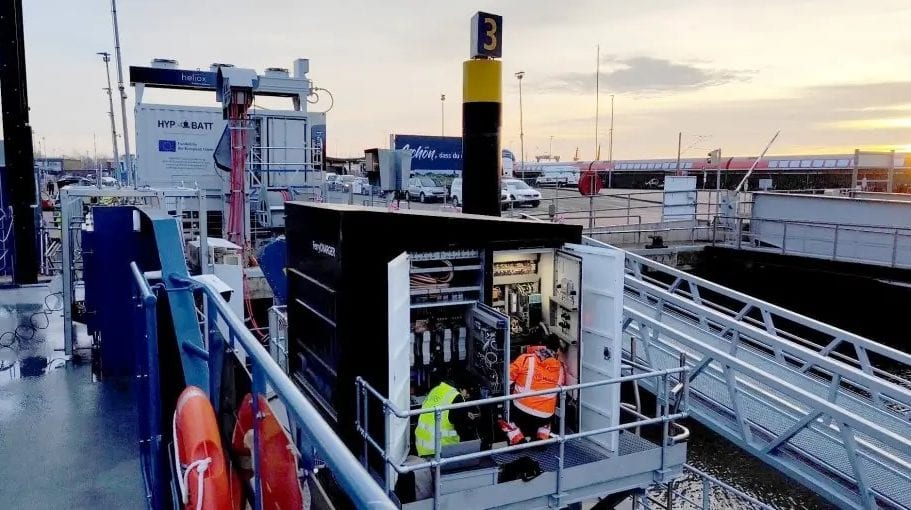
HYPOBATT original photo. For more, please visit the official website.
Image: HYPOBATT
The HYPOBATT project has concluded after testing fast charging for vessels in Germany. Its latest completion update describes a 1 MW pilot and a scalable architecture, placing attention on the connection between shore infrastructure and the time available alongside.
A Completion Update With a Specific Pilot Result
Fundación Valenciaport’s 2 November update reports the conclusion of HYPOBATT following development and testing of the Marine Megawatt Charging System. The Horizon Europe-supported work addresses the challenge of replenishing vessel batteries during short port calls. The update describes a German pilot at 1 MW using automatic and manual connections.
Its stated potential to scale to 2.25 MW should be distinguished from that pilot rating. Megawatts describe charging power; they do not state the vessel’s battery capacity or establish a universal time for a full recharge.
Several Milestones Belong to the Project
Earlier project communication records a public demonstration in Norddeich on 18 February 2026, hosted around Norden-Frisia operations. The November completion statement is therefore a later project update, not evidence that the first demonstration has only just occurred. Reports discussing different stages should not be combined into a single undifferentiated performance claim.
Valenciaport says it led work on replicability and technical-economic feasibility. It also identifies the project’s contribution to the future IEC/IEEE 80005-4 standard for DC shore-to-ship connections. That is work towards standardisation, rather than a declaration that the future standard is already finalised.
Charging Has to Fit a Working Service
For a ferry operator, a charging system belongs within a sequence that includes arrival, connection, passenger handling and departure. The useful measure is how comfortably the whole process fits the service, including the moments before energy begins to flow.
That makes the shore side part of the vessel discussion from the beginning. Available electrical supply, connection arrangements and the pattern of calls need to be considered together. A charging specification becomes more meaningful when it is connected to a particular route and operating plan.
HYPOBATT’s completion provides another practical reference for that work. It supports a conversation about how a tested approach could be adapted elsewhere, with the relevant local assumptions made explicit. The next stage is to turn the lessons of a project into installations whose technical and commercial arrangements fit the ports and vessels they will serve.
Source: Fundación Valenciaport