Electric MarineAUVEMARE / Story 045
Electric River Boating and the Pleasure of Slowing Down
8 October 2026 · 5 min read
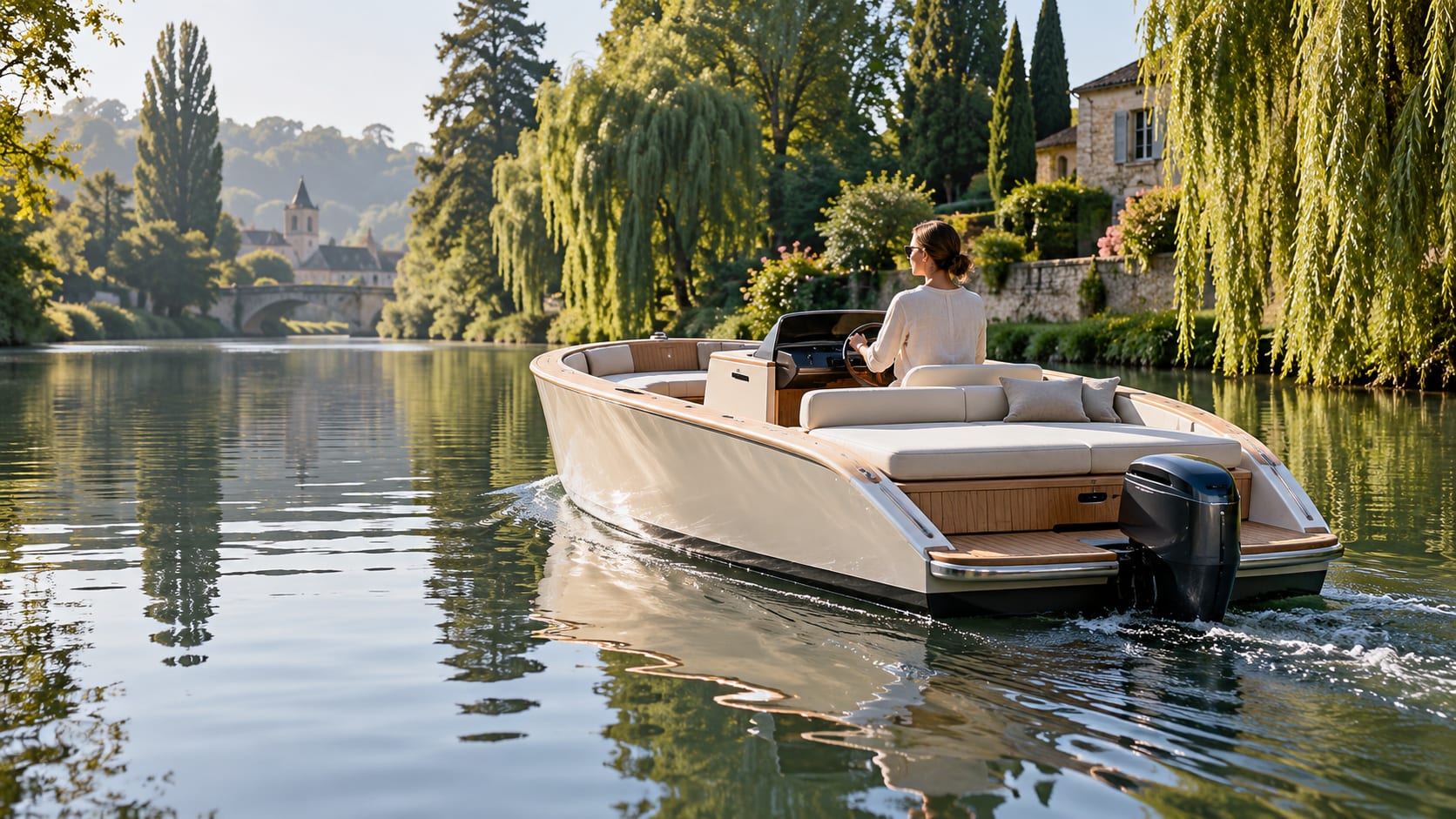
AI-generated editorial illustration of an electric dayboat on a quiet river. The boat and location are fictional.
Image: AUVEMARE / AI-generated with OpenAI. No photographer.
Electric propulsion has a natural place on rivers and canals, where an enjoyable day rarely depends on maximum speed. From European city waterways to American sightseeing routes and India's water transport, the transition is taking several different forms.
There is a particular kind of pleasure in a river journey: following the bank, noticing a waterside house, slowing for a bridge. On these trips, the engine can occupy more of the experience than it needs to. Electric propulsion offers a way to bring the surroundings back into the foreground.
Its appeal is practical as well as atmospheric. A boat used for short outings, returning to a berth with dependable charging, has a different energy requirement from a fast cruiser travelling between unfamiliar ports. That distinction helps explain why some inland applications are a good fit for electrification today, even while other cruising programmes remain more demanding.
Europe: a change shaped by the waterway
Amsterdam provides a clear example of policy influencing the fleet. The city has an emission-free zone for pleasure craft in its central waterways, with temporary access arrangements for certain existing petrol and diesel boats. The rules apply to a defined area; they should not be read as a blanket description of boating across the Netherlands or Europe.
For an owner who regularly uses those waterways, propulsion becomes part of planning where the boat can go. For a rental operator, the same question extends to charging between bookings and preparing the fleet for future seasons. The transition depends on shore-side arrangements as much as the motor itself.
America and beyond: repeatable journeys matter
At Niagara Falls in the United States, Maid of the Mist operates two all-electric sightseeing catamarans. The operator recharges their batteries between trips. This is a useful illustration of electric propulsion built around a repeatable service, rather than a promise that every boat can undertake every journey on battery power.
In India, Kochi Water Metro brings electrically propelled hybrid ferries into a wider transport system connecting communities around its backwaters. Its setting includes lakes, canals and river-fed estuarine waters. Here, electrification is part of public mobility and access, alongside terminals and connections ashore.
These examples serve different passengers, but suggest a shared lesson: a known route and a reliable place to recharge make the energy question easier to answer. They demonstrate working applications, rather than a uniform worldwide replacement of combustion engines.
The electric outboard changes the starting point
An outboard can make electric boating accessible without building an entirely new vessel. Portable systems suit some small craft, while more powerful installations use separate battery banks and integrated controls. Mercury's Avator range, for example, includes both compact battery arrangements and modular systems. Torqeedo and ePropulsion also offer electric outboards for different boat sizes and uses.
The right comparison begins with the boat's displacement, hull, load and intended speed. A familiar combustion-engine horsepower figure alone does not describe how an electric package will perform. Manufacturers' range demonstrations are tied to their test boats and conditions; an owner carrying more people, travelling upstream or seeking a higher speed may see a different result.
Batteries: capacity is only part of the story
Kilowatts describe power; kilowatt-hours describe stored energy. A larger battery can support more operating time, but also adds weight, occupies space and changes the installation. Usable capacity and the energy kept in reserve matter more to a journey than the largest number on a brochure.
Lithium iron phosphate, usually called LFP, and nickel manganese cobalt, or NMC, are both lithium-ion chemistries. Their strengths differ. LFP can be attractive for fixed installations where cycle life matters, while NMC's greater energy density can help in portable or weight-sensitive applications. Neither name, on its own, tells the whole story of a marine battery.
The enclosure, battery management system, charging equipment and installation are also part of the package. An integrated system monitors the battery and manages its operating limits. For an owner, the useful conversation is about the complete installation, its service support and its suitability for the boat.
Quiet cruising still needs a considered plan
Lower engine noise and the absence of local combustion exhaust can improve the experience of a slow passage. Electric propulsion also removes several familiar combustion-engine servicing tasks. It does not remove the need to maintain the boat, inspect connections or look after the propeller and other underwater components.
On a river, the return leg deserves particular attention. Current changes speed over the ground, so an easy downstream run may require considerably more time and energy to retrace. Wind, loading and speed also affect consumption. A range display is useful information for the skipper, rather than an assurance that conditions will stay the same.
Charging should be arranged before departure, including access to the berth supply, the compatible charger and the time available. Solar panels can contribute energy on a suitable installation, but their contribution depends on panel area, weather and propulsion demand. They do not make a battery boat's range unlimited.
Running costs may become attractive with regular use, although the overall calculation includes the initial installation, electricity, battery life and service. Likewise, the wider environmental picture includes battery production and the source of electricity, beyond the boat's lack of local engine exhaust.
For many owners, the strongest reason to change will be simpler than a grand claim about the future: their usual river trip can become quieter, with a charging routine that fits the way they already use the boat.
Source: AUVEMARE original feature