Electric MarineAUVEMARE / Story 075
Electric Boating Is Growing. A Complete Transition Has No Fixed Date.
14 October 2026 · 2 min read
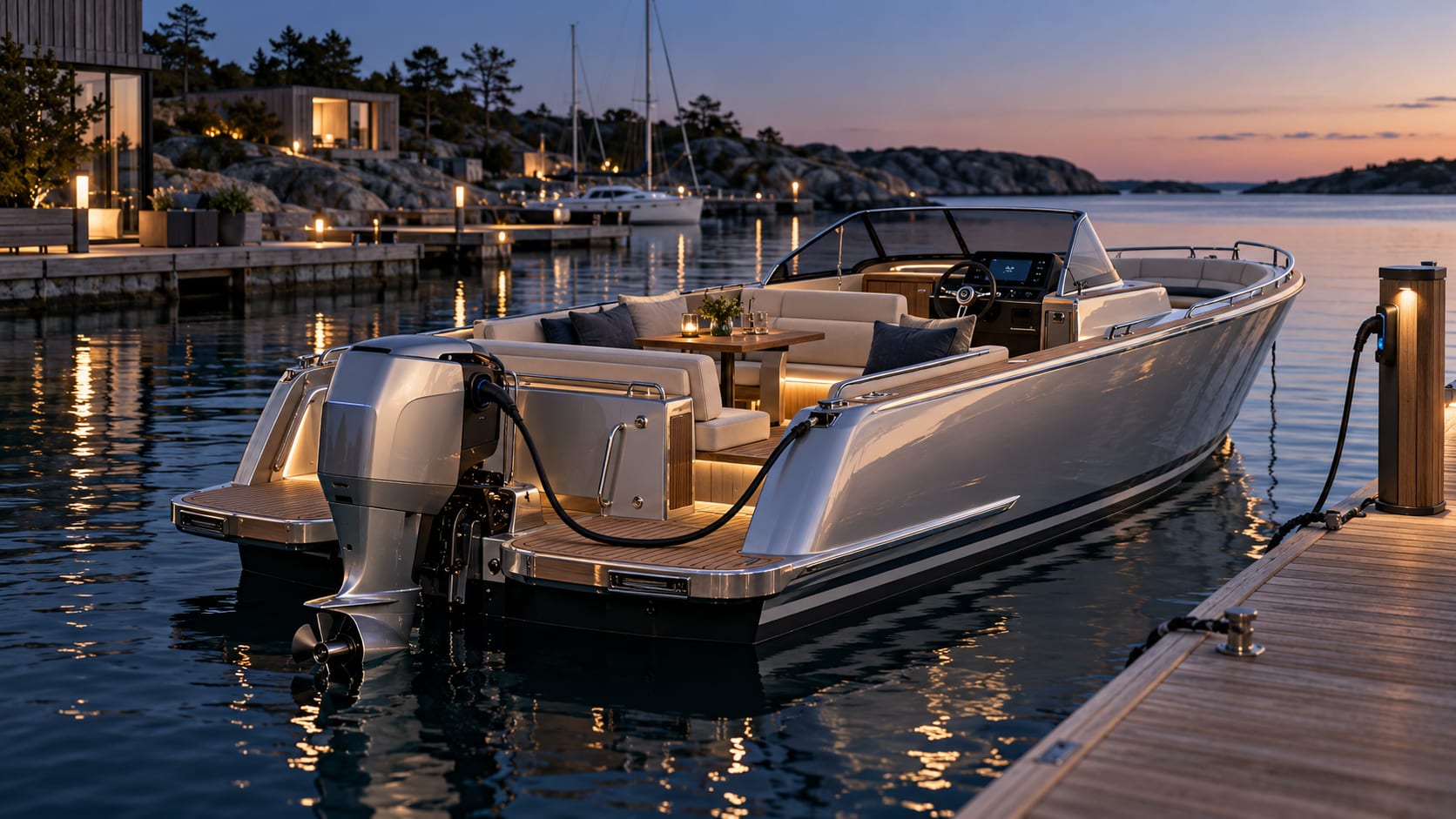
Fictional electric dayboat with an unbranded outboard and charging connection at a marina at blue hour. AI-generated illustration; not a photograph of a commercial model or a measured demonstration of emissions or range.
Image: AUVEMARE / AI-generated with OpenAI. No photographer.
Electric propulsion can make suitable boating routines quieter and remove exhaust at the point of use. Market forecasts suggest growth in Europe and the United States, but revenue shares cannot tell us how much of either fleet already runs on electricity.
Why the Change Matters
The appeal begins with the experience aboard: quieter manoeuvring, less vibration and no exhaust from a battery-electric motor. Fewer combustion-engine components can simplify some maintenance tasks. Whether ownership becomes cheaper depends on purchase cost, battery replacement, electricity prices and the hours actually operated.
The environmental calculation also extends beyond the transom. ICOMIA’s Ricardo-led lifecycle study considers manufacturing, energy supply and use across different recreational craft. Its central finding is that boating needs several decarbonisation approaches. A lightly used boat with a large battery cannot be judged by exhaust alone; a frequently used craft on predictable routes presents a different case.
Europe and America: What the Percentages Mean
Grand View Research estimates Europe’s electric-boat market revenue at $2.509 billion in 2024, representing 37.0% of its global electric-boat market. Its US report estimates $2.49 billion for the same year. Against the publisher’s $6.78 billion global figure, that implies approximately 36.7%, calculated by AUVEMARE.
Neither percentage is an electric usage rate. They describe regional shares of a revenue-defined market that includes hybrid propulsion. They do not mean 37% of European boats, or 36.7% of American boats, are battery electric. The public sources reviewed do not provide comparable, verified fleet-wide electric-use percentages for Europe and the United States. That measure remains unavailable here rather than estimated from unrelated statistics.
The same publisher forecasts European revenue of $4.791 billion by 2030, with 11.9% annual compound growth during 2025–2030. For the United States, it forecasts $5.32 billion and 14.0%. These are commercial forecasts, not observed adoption rates or promises of complete replacement.
Why There Is No Universal Changeover Year
An electric tender returning to a powered berth and a vessel travelling offshore have different energy requirements. Charging access, useful range, battery mass, reserve capacity and the service network determine where a system is practical. New sales and replacement of the existing fleet also move at different speeds.
The reports reviewed do not establish a year when all boats will become electric. International shipping’s IMO ambition of net-zero greenhouse-gas emissions by or around 2050 is another measure altogether: it is neither an all-electric requirement nor a deadline for recreational fleets. Batteries, hybrid arrangements and other energy pathways can serve different operating needs.