SuperyachtsAUVEMARE / Story 074
What a Superyacht Costs After the Purchase
14 October 2026 · 2 min read
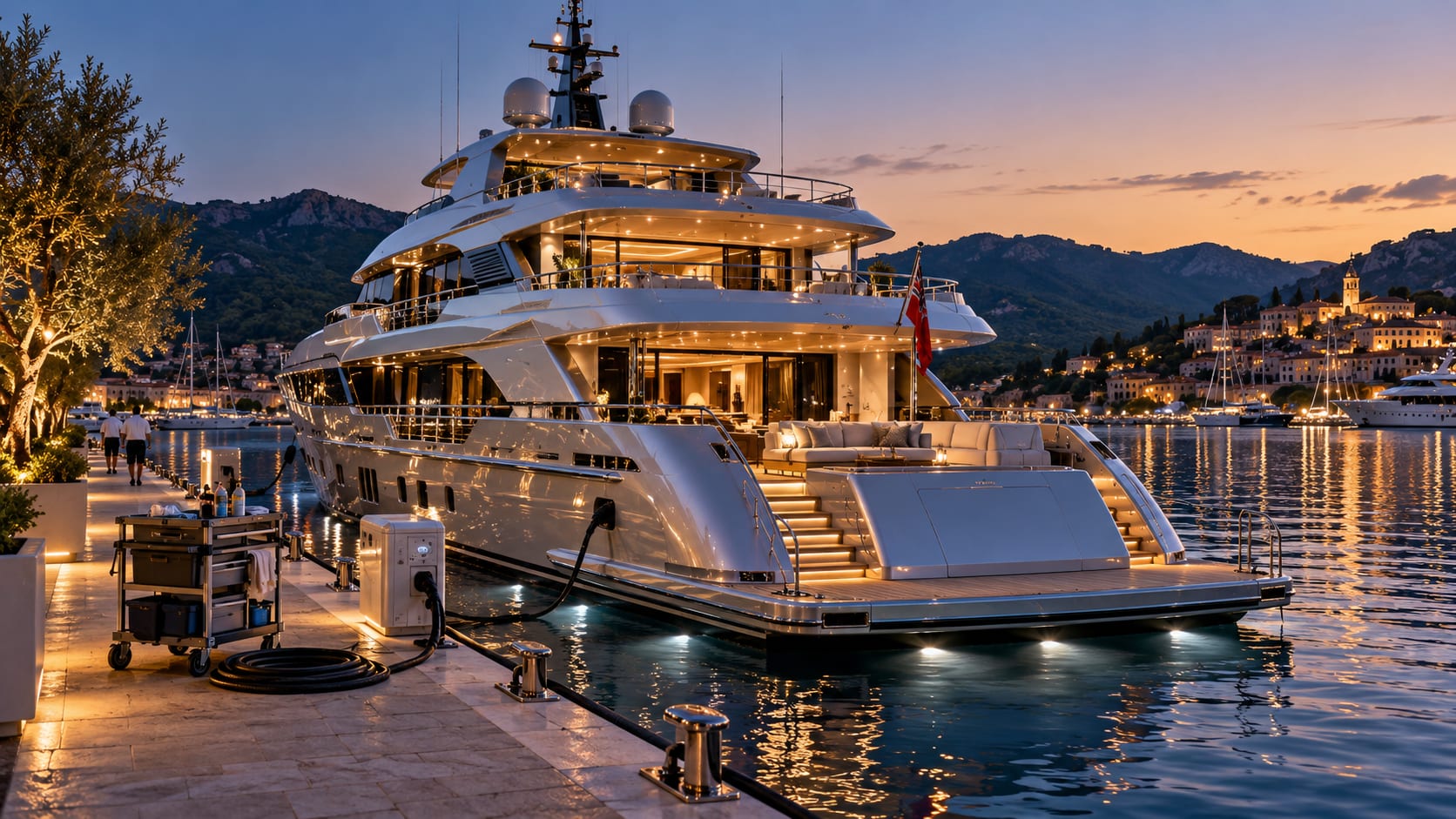
Fictional motor superyacht berthed in a Mediterranean marina at blue hour, with dockside equipment suggesting the work behind ownership. AI-generated editorial illustration; not a specific yacht or a documented maintenance operation.
Image: AUVEMARE / AI-generated with OpenAI. No photographer.
A superyacht budget starts with the life an owner wants aboard. An illustrative 40-metre operating model shows how crew, maintenance, fuel and future refits can matter more than a simple percentage of the purchase price.
Budget the Yacht You Intend to Use
A purchase price settles one question. It does not explain what the yacht will cost to keep ready. Y.CO identifies condition, size and service scope as factors in management pricing; those same differences make a single ownership percentage an unreliable substitute for a vessel-specific budget.
For a worked example, consider a privately operated 40-metre motor yacht with eight crew, 300 annual cruising hours and 60 owner-use days. Every figure below is an AUVEMARE modelling assumption, not a quotation, market average or surveyed fleet result. Actual contracts and technical records must replace them before an acquisition decision.
An Illustrative Annual Budget
For context, Drivas Yachts publishes indicative annual Mediterranean berthing of €80,000–€180,000 for a 40-metre yacht and insurance of 0.5%–1.5% of agreed hull value. These are a broker’s planning ranges, not tariffs or quotations.
Allow €850,000 for crew employment, including associated costs; €400,000 for routine technical maintenance and consumables; €120,000 for berthing; and €100,000 for insurance. Add €75,000 for management and administration, plus €80,000 for provisions and other owner-use services.
Fuel is calculated separately. At an assumed combined propulsion consumption of 300 litres per cruising hour, 300 hours require 90,000 litres. An additional 50,000 litres for generators and other fuelled operation brings the total to 140,000 litres. At an assumed delivered price of €1.20 per litre, the fuel allowance is €168,000. This consumption profile describes our scenario, not a particular yacht’s performance.
These items total €1,793,000. Setting aside another €200,000 for future refits brings annual funding to €1,993,000, approximately €166,083 per month. The reserve is money allocated for later work, rather than an assertion that the same refit expense occurs every year.
Change the Assumptions Before Changing the Yacht
Dividing that funding by 60 owner-use days gives approximately €33,217 per day. At 30 days, it becomes €66,433. These are annual-cost allocation figures, not charter prices or the marginal expense of another day aboard.
Fuel at €1.50 per litre would add €42,000. Another 100 cruising hours at the assumed consumption would add €36,000 at the original fuel price. Neither change removes the need to fund crew, a berth or planned maintenance.
Purchase costs, financing, depreciation, taxes, exceptional failures and major refits beyond the reserve are excluded. No charter income is assumed. A working budget also needs a separately agreed contingency and a calendar showing when bills become payable.